
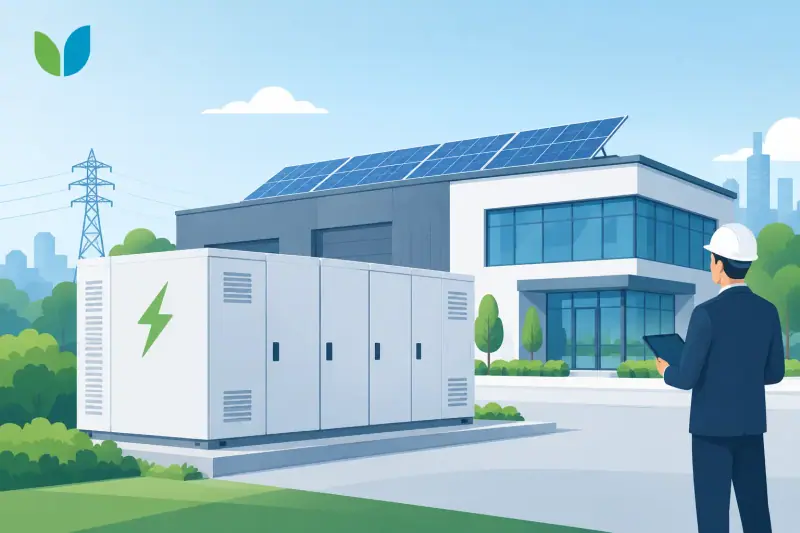
A business that generates solar power at midday but buys expensive electricity again at 6pm has an obvious opportunity. This guide to business battery storage explains how commercial batteries can retain lower-cost energy for the moments your site needs it most, reducing reliance on the grid without making assumptions about your usage or savings.
For many UK businesses, battery storage is not simply an add-on to solar. It is a practical way to manage volatile energy costs, make better use of an existing solar array and maintain greater control over when electricity is purchased. The right system begins with your actual consumption pattern, rather than a one-size-fits-all battery size.
What business battery storage does
A commercial battery stores electricity for later use. It can charge from excess solar generation, from the grid when rates are lower, or through a combination of both. When demand rises, solar output falls or electricity prices increase, the battery discharges to support the property.
This can be particularly valuable for offices, warehouses, retail premises, schools, workshops and multi-use commercial sites where energy use continues beyond daylight hours. A battery does not create electricity, but it gives you more choice over how and when you use the electricity you generate or buy.
The most effective systems are designed around three connected factors: half-hourly or interval usage data, solar generation where applicable, and the tariff structure available to the business. Looking at only one of these can lead to a battery that is too small to make a meaningful difference, or too large to justify its cost.
When a business battery makes financial sense
Solar surplus is often the first reason businesses consider storage. Without a battery, unused generation may be exported to the grid for a lower value than the cost of electricity later imported. Storing some of that energy for use after the working day, or during a high-demand period, can improve the return from the solar system.
Time-of-use tariffs create another opportunity. If your tariff offers cheaper overnight or off-peak electricity, a battery may charge during those lower-cost periods and discharge when rates are higher. This approach needs careful modelling. The battery has charging and conversion losses, and tariff savings must be sufficient to cover those losses and contribute towards the system investment.
For some larger sites, reducing peak demand can matter as much as reducing total consumption. A battery can be set to discharge during short, predictable demand spikes, helping to flatten the site’s load profile. Whether this reduces charges depends on the supply contract and how network and demand-related charges are applied, so it should be assessed alongside your energy broker or supplier information.
Battery storage can also support continuity planning, but it should not automatically be treated as full backup power. Many standard battery systems switch off during a grid outage for safety. If resilience is a priority, the design needs suitable backup capability, essential-load circuits and an agreed plan for what the battery will power.
Choosing the right battery size for your site
Battery capacity is measured in kilowatt-hours (kWh), while power is measured in kilowatts (kW). Capacity tells you how much energy the battery can hold. Power tells you how quickly it can charge or discharge. Both matter.
A 100 kWh battery with limited discharge power may not cover a sharp peak from machinery, refrigeration or electric vehicle charging. Equally, a high-power battery with too little capacity may empty quickly and provide limited benefit through the evening. The correct balance comes from studying the shape of your demand, not just your annual electricity bill.
A professional site survey and design process should consider:
- your half-hourly consumption data and the times at which demand peaks
- existing or planned solar generation, including seasonal output
- the building’s incoming supply, distribution board capacity and available installation space
- planned changes such as electric vehicles, heat pumps, extended operating hours or new equipment
- tariff rates, export arrangements and any contractual constraints
It is also worth considering whether a modular system is more suitable. A business expecting to add more solar, chargers or electrical equipment may benefit from a battery design that can expand later. This can protect against overinvesting too early while keeping a clear route for growth.
A guide to business battery storage and solar
Solar and batteries work well together because their strengths are complementary. Solar produces clean electricity when daylight is available. A battery shifts some of that value into later hours, when a business may still have lighting, IT equipment, refrigeration, security systems or staff facilities drawing power.
However, a battery does not mean every unit of solar generation should be stored. In many cases, it is best to use solar power directly first, because direct use avoids the small losses involved in charging and discharging a battery. The system should then store the surplus that is likely to be more valuable later than it is when exported.
Seasonality matters too. Solar surplus can be substantial in summer and much lower in winter, while a battery may still find value through tariff charging. A sound proposal models a range of realistic conditions rather than relying on one exceptional sunny month.
Installation considerations that should not be overlooked
Commercial battery storage requires more than selecting a battery unit. The proposed location needs adequate access, ventilation and clearance, with fire safety, manufacturer requirements and relevant electrical standards considered from the outset. Outdoor cabinets can suit some sites, while others have a suitable plant room or protected internal area.
The electrical connection is equally important. Your installer should assess the existing supply, distribution equipment and protection settings, then identify whether any upgrades or permissions are required. Grid connection requirements can vary according to the system size and operating mode. Starting this process early avoids an installation programme being held up by avoidable technical issues.
Monitoring should form part of the design, not an afterthought. Clear monitoring allows you to see solar generation, battery charge, grid imports and exports, and site consumption in one place. It also helps identify unusual use patterns and gives your installer the information needed to provide effective support.
At Infused Solar Energy, commercial systems are designed around the property and its energy goals, with the survey, design, installation and aftercare managed as one clear process. For a business owner, that means fewer gaps between the initial proposal and the system operating as intended.
Questions to ask before approving a proposal
A good battery proposal should be easy to understand. Ask how the recommended size was calculated, which assumptions have been made about future electricity prices and what level of solar surplus is expected. You should also ask whether the projected savings include battery losses, degradation over time and any ongoing monitoring or maintenance costs.
Clarify the warranty in practical terms. Battery warranties typically cover a defined period, energy throughput or retained capacity, subject to the manufacturer’s conditions. Understand who will handle a fault, how monitoring alerts are dealt with and whether the installer remains available after commissioning.
Finally, be clear about the purpose of the system. Is the priority to maximise solar self-consumption, reduce peak demand, use off-peak tariffs, provide selected backup, or achieve a combination of these? A battery can often do several jobs, but the settings should reflect the outcome that matters most to your business.
Getting from idea to a working system
The best starting point is usually a review of at least 12 months of energy data, alongside details of your current tariff and any solar system already installed. This reveals the patterns that an annual bill alone cannot show: when your site uses energy, how high demand rises, and where solar generation is currently going.
From there, a properly considered design can set out the recommended battery capacity and power, expected operating strategy, installation requirements and realistic financial case. The numbers should be transparent enough for you to compare options with confidence.
Business battery storage is most valuable when it reflects the way your premises actually operate. Start with your data, plan for the changes ahead, and choose a system that gives your business more useful control over every unit of energy it buys or generates.