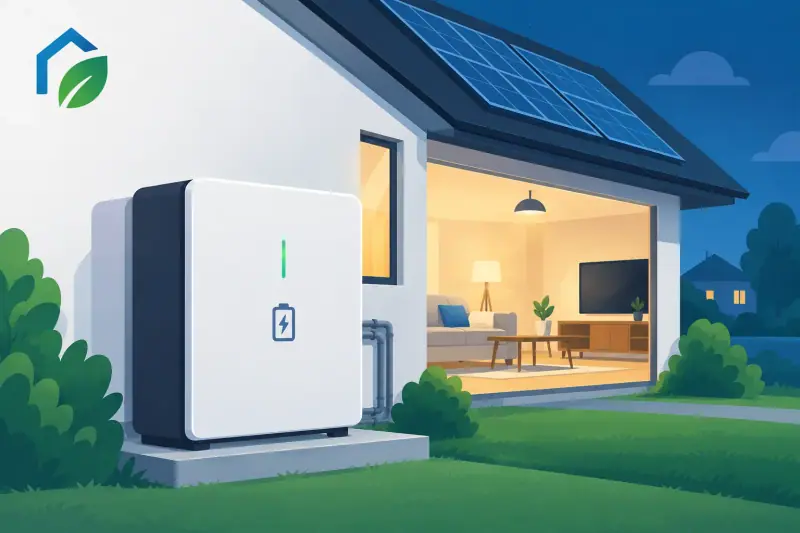

Your solar panels may generate their most useful electricity while the house is empty. Then, just as the kettle goes on, dinner is cooked and devices start charging, the sun is lower and you are buying electricity from the grid. A thoughtful home battery review UK should start with that gap between when you generate power and when you need it.
Battery storage is not automatically the right answer for every property. But for many households, it is a practical way to use more of their own solar generation, benefit from lower overnight tariffs and take greater control of rising energy costs. The best result comes from matching the battery, solar array and tariff to how your household actually uses energy.
What a home battery changes
A home battery stores surplus electricity for later use. In a typical solar setup, it charges when your panels are generating more than the home needs. Rather than exporting all of that unused power to the grid, you can use it later in the evening.
Modern batteries can also charge from the grid during low-cost tariff periods. That stored electricity can then help cover higher-priced periods, even on darker days when solar generation is limited. This makes battery storage useful beyond the summer months, although the level of savings will vary.
For a household with solar panels, the aim is usually to increase self-consumption: using more of the electricity generated on your own roof. For a household without solar, a battery can still work with a suitable time-of-use tariff, but the financial case needs closer examination because you are buying all of the energy that goes into it.
Home battery review UK: what matters most
It is easy to compare batteries by their headline capacity alone. Capacity matters, but it does not tell the whole story. The right system should be assessed against your energy habits, the performance of your solar panels and your future plans.
Usable capacity, not just the number on the box
Capacity is measured in kilowatt-hours (kWh). A 10kWh battery can theoretically store 10 units of electricity, but the usable amount may be slightly lower depending on the manufacturer’s recommended depth of discharge and reserve settings.
A smaller battery may be enough for a couple with modest evening use. A larger family, an electric vehicle, electric heating or regular daytime export may justify more storage. Bigger is not always better: an oversized battery can sit partly unused for much of the year, making the payback less attractive.
As a broad starting point, many solar homes consider batteries in the region of 5kWh to 15kWh. A site survey and consumption review provide a far better answer than a one-size-fits-all recommendation.
Power output affects how the battery feels to use
Capacity tells you how much energy can be stored. Power output, measured in kilowatts (kW), tells you how quickly the battery can deliver it.
If the oven, kettle, dishwasher and washing machine are all running, a low-output battery may not cover the entire demand. You will still import some electricity from the grid, even if the battery has plenty of charge remaining. A suitably specified inverter and battery output help the system support real household peaks, not just a small background load.
Your tariff can be as important as the hardware
The value of a battery changes substantially depending on your electricity tariff. If you are on a flat-rate tariff and export excess solar at a reasonable rate, savings may be modest compared with a household on a tariff with cheap overnight electricity and expensive peak-time rates.
A well-designed system can be configured to charge when electricity is cheaper, preserve solar energy where appropriate and avoid unnecessary grid imports. Tariffs change, so it is sensible to choose equipment with flexible monitoring and controls rather than basing the entire decision on one current rate.
Backup power is a separate feature
Many homeowners assume a battery will keep everything running during a power cut. This is not always the case. Standard battery systems often shut down with the grid for safety reasons.
If backup power is important, this must be planned into the design. Some systems can support selected essential circuits, such as lighting, refrigeration, broadband and a few sockets. Whole-home backup may be possible in some properties, but it requires careful consideration of load, equipment specification and budget. It is worth deciding what you genuinely need to keep running before paying for a feature you may rarely use.
What does a home battery cost in the UK?
Installed home battery costs vary with capacity, brand, inverter compatibility, electrical work, backup requirements and whether the battery is being added to an existing solar system. A typical residential installation may range from several thousand pounds for a modest setup to considerably more for larger capacity, multiple batteries or advanced backup capability.
The lowest quote is not necessarily the best value. Battery systems are expected to work safely for years, communicate correctly with the inverter and provide useful monitoring data. The installation should include a clear design, compatible components, appropriate electrical protection and an explanation of how the system will operate day to day.
For homes adding a battery to existing solar, compatibility is particularly important. An AC-coupled battery can often be retrofitted without replacing the solar inverter. A DC-coupled arrangement can be highly efficient when designed as part of a new solar installation. Neither approach is universally superior: the best choice depends on the equipment already installed and your objectives.
How much could you save?
There is no honest single savings figure for every UK household. Your result depends on solar generation, electricity consumption, export payments, import tariff rates, battery size, weather and how actively the system is used.
Consider two homes with the same 10kWh battery. One is occupied during the day, runs appliances from solar power and has modest evening demand. The other is empty until 6pm, has a larger evening load and imports expensive electricity at peak times. The second home may see greater value from storing daytime solar, despite having the same hardware.
The most useful proposal should show estimated generation, expected battery charging behaviour, projected imports and exports, and the assumptions behind any savings calculation. Treat figures as informed estimates, not guarantees. Weather, tariff changes and household habits will always influence the final outcome.
Choosing a battery size that suits your home
Start with your electricity bills and smart meter data if available. Look at total annual consumption, but also consider when the household uses electricity. Evening-heavy use is often a strong case for solar battery storage.
Then consider likely changes over the next few years. An electric vehicle, heat pump, home office or growing family can change demand quickly. It may be sensible to choose a scalable battery system that can be expanded later, rather than paying for maximum capacity from day one.
Solar array size matters too. A large battery paired with a small solar array may not charge fully from solar for much of the year. Conversely, a strong solar array that regularly exports electricity could benefit from more storage. Professional system design brings these figures together rather than treating each component in isolation.
Questions to ask before you buy
Before accepting a quote, ask whether the stated battery capacity is usable capacity, what the maximum discharge power is, and how the system will work with your current or proposed electricity tariff. You should also ask about product warranties, installation workmanship cover, monitoring access and what support is available if performance does not look right.
For an existing solar installation, ask whether the proposed battery is compatible with your inverter and whether any changes are needed to the consumer unit or electrical supply. If power-cut protection is promised, clarify exactly which circuits will be covered and for how long.
A clear answer to these questions is often more valuable than a sales pitch focused on one impressive headline figure.
A battery is most valuable when it fits the whole system
A home battery is not simply an add-on box in the garage. It is part of a wider energy plan that includes your solar generation, household demand, tariff and future electrification plans. When these elements are designed together, storage can make your solar investment work harder and make daily energy use feel far more predictable.
At Infused Solar Energy, our approach is to assess the property and the customer’s goals before recommending a system. The right battery should give you useful control and confidence, not a complicated setup to manage. Own your energy by choosing a solution that fits the way you live, now and in the years ahead.