If your solar panels are generating most when the house is quiet, while you buy electricity back at peak evening rates, battery storage can change the value of every unit you produce. Knowing how to add solar battery storage starts with one practical question: can your current system store energy safely and efficiently? For most UK homes, the answer is yes, but the right solution depends on your inverter, your typical electricity use and what you want the battery to achieve.
A battery is not simply an add-on box. It should be designed around your home, your existing solar generation and the way your household uses power. Done properly, it lets you keep more of the electricity your panels generate, reduce reliance on the grid and take greater control of your energy.
Why add a battery to an existing solar system?
Without a battery, surplus solar electricity is usually exported when generation is high, often in the middle of the day. That export can still earn money through a Smart Export Guarantee tariff, but it may be worth less to you than using the same electricity later.
A home battery stores suitable surplus generation for use after sunset, in the morning, or whenever household demand exceeds solar output. It can be especially useful for homes where people are out during the day, households with electric vehicles, and families whose highest consumption is between late afternoon and bedtime.
Battery storage can also charge from the grid on certain time-of-use tariffs. This can be worthwhile when off-peak electricity is substantially cheaper, although it needs careful setup. Charging a battery at a low rate and using that energy during an expensive period may reduce bills, but tariff rates, standing charges and your actual usage pattern all matter.
The goal is not to become completely off-grid. In the UK, winter solar generation is lower and grid supply remains valuable. The smarter aim is to increase self-consumption, reduce costly imports and make the energy you generate work harder for your home.
How to add solar battery storage: start with compatibility
The first step is a site survey and system review. An installer should check the make, model and age of your existing inverter, the size of your solar array, your consumer unit, meter arrangement and available installation space. They should also look at generation data if monitoring is already in place.
There are two main ways to add battery storage.
AC-coupled battery systems
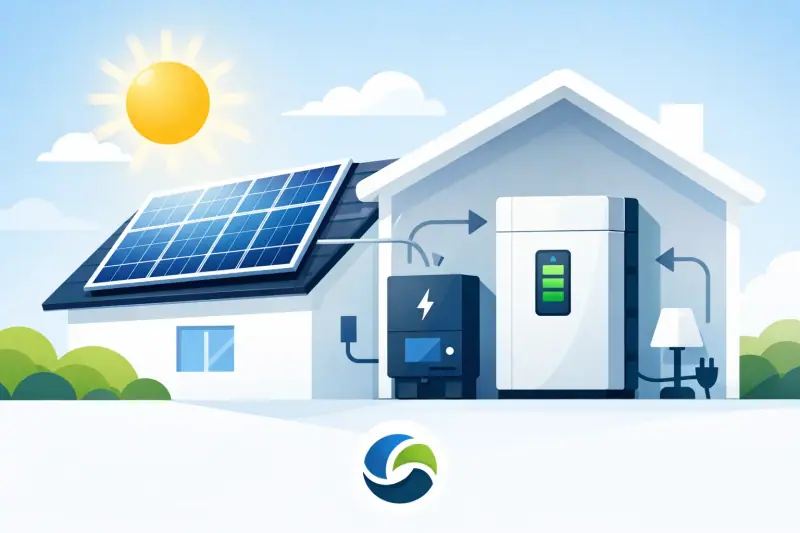
An AC-coupled battery has its own battery inverter and connects alongside your existing solar inverter. It is often the most straightforward retrofit option because it can work with many established solar systems without replacing the original inverter.
This approach is particularly suitable where an existing inverter is functioning well and has years of useful life left. It does involve an additional conversion step when solar power is stored and then used, so efficiency can be marginally lower than a DC-coupled design. In practice, the convenience and compatibility of an AC-coupled system often make it the sensible choice.
DC-coupled battery systems
A DC-coupled battery connects on the DC side of a hybrid inverter. This can be highly efficient because power from the panels can charge the battery before being converted for household use.
However, retrofitting this arrangement may mean replacing the existing solar inverter with a hybrid inverter. That can make sense if your inverter is nearing the end of its warranty, is underperforming, or you want to upgrade the wider system. It is not automatically the best route for every home, particularly where the current inverter is reliable.
A professional proposal should clearly explain which option is being recommended and why. Compatibility should never be assumed from a photograph of the inverter label alone.
Choose a battery size around your real usage
A bigger battery is not always a better investment. If the battery is too small, it may fill quickly and leave excess solar to export. If it is too large, it may sit partly unused for long periods, particularly through autumn and winter.
For many homes, battery capacity is considered alongside daily electricity consumption and the amount of regular solar surplus. A household using around 10 kWh per day does not necessarily need a 10 kWh battery. Some of that demand occurs while the panels are already producing, and some may be difficult or uneconomic to cover from storage.
It is also important to distinguish battery capacity from power output. Capacity, measured in kWh, is how much energy the battery can hold. Power, measured in kW, affects how much it can supply at one time. A battery with a modest discharge rate may not cover a kettle, oven, shower and other heavy loads all at once, even if it has plenty of stored energy.
Your installer should use your half-hourly smart meter data, where available, or a realistic assessment of your household routine. Tell them about planned changes too, such as an electric vehicle, heat pump, home office or growing family. Designing for the home you expect to have can be wiser than designing only for last year’s bills.
Think carefully about backup power
Many homeowners assume a solar battery will keep the entire house running during a power cut. That is not always the case. Standard battery installations often switch off when the grid fails, partly to protect network engineers working on local lines.
Some systems can provide backup, but the level of backup varies. A basic arrangement may power a dedicated emergency socket. A more comprehensive setup can support selected essential circuits, such as lighting, broadband, refrigeration and a few sockets. Whole-home backup is possible in some properties, but it requires suitable equipment, careful load management and a clear understanding of high-demand appliances.
If resilience matters to you, raise it at the survey stage. It is much easier to specify essential backup circuits before installation than to discover later that the system was designed only for bill savings.
Installation, permissions and safety checks
Battery storage should be installed by qualified professionals who understand both electrical safety and solar system design. The work typically includes mounting the battery in an appropriate location, fitting protective equipment, connecting it to the inverter or supply, configuring monitoring and testing the system.
Placement matters. Batteries are commonly installed in a garage, utility room or another suitable area with adequate access and ventilation. The final location must meet the manufacturer’s requirements and current safety guidance. An installer should explain any space, temperature and fire-safety considerations rather than treating the battery as a simple cupboard appliance.
Your installer must also consider the local electricity network. Depending on the equipment and export capacity, notification or prior approval through the Distribution Network Operator may be required under G98 or G99 procedures. This is a normal part of a correctly managed installation, not an administrative detail to skip.
For peace of mind, ask what paperwork you will receive. This should include electrical certification, commissioning records, product warranties, system handover information and guidance on how to use the monitoring app. Where applicable, MCS-certified installation work can also support eligibility for export payments and provides an additional level of assurance.
Make the battery work for your tariff
Once installed, a battery needs sensible settings. The best configuration differs between households. A family that exports large amounts of summer solar may prioritise solar charging and evening discharge. A home on a flexible time-of-use tariff may benefit from scheduled overnight charging during lower-priced periods, while preserving enough capacity to capture next day’s solar.
This is where monitoring earns its place. Check how much solar is being generated, stored, imported and exported over the first few weeks. Small adjustments to charge windows, reserve levels and export settings can improve results, but chasing daily perfection is rarely necessary. Energy habits change with the seasons, and a good system should adapt with them.
Do not judge performance only by how full the battery looks. A battery that regularly cycles through useful energy is generally doing more for your bills than one held at 100% waiting for an unlikely power cut. If backup is your priority, keeping a reserve may be worthwhile, but that is a trade-off between resilience and day-to-day savings.
What to expect from a professional retrofit
A well-planned battery retrofit should feel clear from the first survey to the final handover. You should receive an explanation of the recommended battery size, expected behaviour, any limitations of the existing solar system and the costs involved. Promises of fixed savings without reviewing usage data deserve caution.
At Infused Solar Energy, systems are designed around the property rather than a one-size-fits-all package. That means considering the technical details, but also the practical outcome: helping you use more of your own electricity with confidence and support after installation.
The best time to add a battery is when the design fits your household, tariff and future plans. Start with accurate usage data, ask direct questions about compatibility and backup, and choose an installer who will explain the trade-offs plainly. Your solar panels have already started producing clean energy: a thoughtfully chosen battery can help you keep more of it when it matters most.