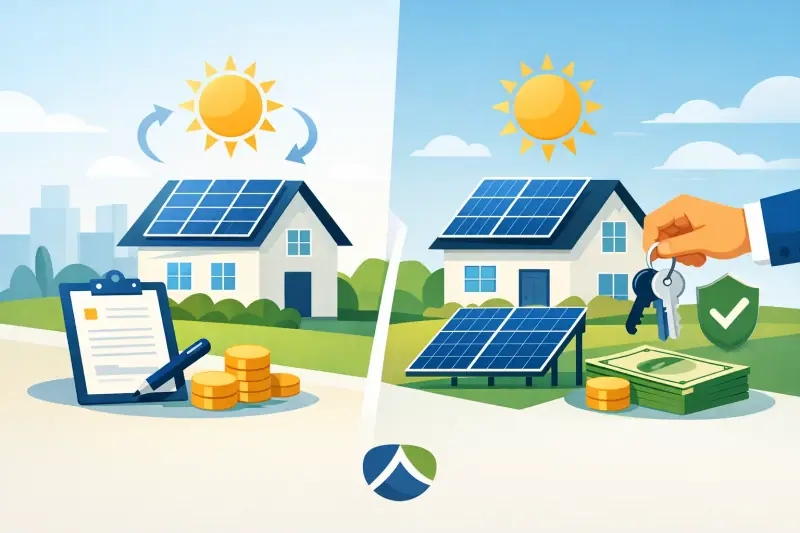
A solar quote can look very different depending on who will own the panels. In the solar lease vs purchase decision, the monthly figure is only part of the story. The agreement affects who receives the export income, who controls future upgrades, how a property sale is handled and how much value the system can deliver over its lifetime.
For most UK homeowners, buying a professionally designed solar system is the clearer route to long-term savings and energy independence. A lease can reduce the upfront barrier, but it also means accepting less control and sharing more of the financial benefit. The right answer depends on your budget, property plans and appetite for ownership.
What does it mean to lease solar panels?
A solar lease allows a third party to install panels on your roof while retaining ownership of the equipment. You pay a regular monthly amount for the use of the system, or in some arrangements, you buy the electricity it generates at an agreed rate. Commercial properties may encounter this structure as a power purchase agreement, often called a PPA.
The attraction is straightforward: little or no upfront capital is required. The provider normally takes responsibility for installing, monitoring and maintaining the panels, depending on the contract. You can use solar-generated electricity in the building and reduce the amount bought from the grid.
However, terms vary widely. Some agreements include annual price rises; others have fixed terms lasting 15 to 25 years. You need to know who benefits from export payments, what happens if the system underperforms, whether battery storage can be added, and what it costs to end the agreement early. Older rent-a-roof schemes can be particularly restrictive when a home is being sold or remortgaged.
What does purchasing a solar system involve?
When you purchase solar panels outright, you own the system from installation. You can pay in cash or use suitable solar finance, although finance is not the same as leasing. With finance, you are still buying the asset and working towards full ownership under the terms of the agreement.
Ownership gives you the full benefit of every unit of electricity you use instead of importing from the grid. Subject to eligibility and the relevant registration, it also means you can receive Smart Export Guarantee payments for surplus electricity sent back to the network. You decide whether to add a battery later, change electricity tariff, expand the system where feasible, or arrange maintenance with an installer you trust.
There is an upfront cost, which is the main reason some households consider a lease. But a well-sized solar system is a long-term home investment, not a short-term utility product. Once paid for, the panels continue generating electricity for many years, while your ongoing costs are generally limited to occasional maintenance, insurance considerations and eventual equipment replacement where needed.
Solar lease vs purchase: the financial difference
A lease can make solar feel affordable because it replaces a larger initial payment with a smaller monthly commitment. That does not automatically make it cheaper. Over a long agreement, lease payments can add up to more than the cost of purchasing a system, while the provider retains ownership of an asset on your roof.
Buying asks you to make the investment first, then receive the savings directly. The payback period depends on your electricity use, system size, roof orientation, shading, tariff, export rate and whether you use a battery. A household that is home during the day may use more generation as it is produced. A household that is out at work can still benefit, but may gain more by shifting appliance use or storing excess power in a battery.
The key calculation is not simply, “What will I save this month?” It is, “Who keeps the value over the next 20 to 30 years?” With ownership, lower imported electricity, export income and any property appeal attached to a quality installation sit with you. With a lease, your savings may be real, but they are usually shared through the provider’s pricing model.
For a business, the comparison should also include capital availability, accounting treatment, site occupancy and long-term operating costs. A PPA may suit an organisation that wants predictable solar electricity without tying up capital. A business that owns its premises, expects to remain there and can fund the project may find ownership produces a stronger long-term return.
Control matters more than many people expect
Solar is not a fit-and-forget decision made only on installation day. Your energy needs can change. You may buy an electric vehicle, install a heat pump, work from home more often or want battery storage to make better use of your generation.
With a purchased system, these choices are yours. A good installer can design with future expansion in mind, explain any limits from the inverter or roof space, and provide ongoing support after the installation. You can also choose how to use your energy, including smart charging and time-of-use tariffs where they suit your household.
A leased system may limit alterations because the provider owns the panels and associated equipment. Adding a battery, replacing a roof, changing the system layout or having another contractor work on the equipment may require permission. Read the contract carefully rather than assuming future changes will be simple.
Selling, remortgaging or repairing the roof
This is where the small print deserves real attention. A purchased solar system should be recorded clearly in the property paperwork, with warranties, installation documents and relevant certificates kept safely. Buyers often see owned solar as a practical benefit, especially when the system is well maintained and performance information is available.
A lease creates an ongoing legal agreement connected to the property or occupier. When selling, a buyer and their lender may need to review and accept that agreement. This is not always a deal-breaker, but it can introduce questions, delays and administration at a time when you want a straightforward sale.
Roof work is another consideration. Panels occasionally need to be removed and reinstalled for major repairs or reroofing. If you own the system, you arrange this work and pay the associated cost. Under a lease, the provider’s process, timescales and charges will apply. Ask for these details before signing, not after scaffolding is required.
When a solar lease can make sense
Leasing is not inherently wrong. It can be a workable option for a property owner or business with no available capital, a strong need to reduce grid purchases now, and no expectation of major changes to the building or energy system during the contract term.
It may also appeal where a reputable provider offers clear performance commitments, comprehensive maintenance and fair transfer provisions. The agreement must be transparent about price increases, export rights, insurance, end-of-term options and removal costs. If any part is vague, treat that as a reason to pause.
For homeowners, it is worth exploring whether solar finance, staged home-improvement funding or a smaller owned system could achieve the same aim with greater long-term control. The lowest upfront cost is not necessarily the smartest overall value.
Questions to ask before choosing
Before comparing quotations, establish whether the proposal is a lease, a PPA, a loan or an outright purchase. These are fundamentally different arrangements, even when the monthly payment looks similar.
Ask who owns the panels and inverter, who receives export payments, and whether there are annual payment increases. Confirm the contract length, early-exit cost, maintenance responsibility, system performance expectations and terms for selling the property. You should also ask whether battery storage can be added and who pays if the panels need removing for roof repairs.
For a purchase quote, look beyond panel quantity. A tailored design should consider your roof, daytime consumption, future electricity use, shading and the practical benefits of battery storage. MCS-certified installation, clear warranties, monitoring setup and responsive aftercare all protect the value of your investment.
A better way to make the decision
Start with your plans for the property. If you expect to stay for years and want more control over bills, charging and future upgrades, purchasing is usually the stronger fit. It puts the asset and its long-term benefit in your hands.
If avoiding upfront cost is essential, compare a lease against ownership finance line by line, not just by monthly payment. Make sure you understand the lifetime commitment before signing. At Infused Solar Energy, the focus is on clear, bespoke system proposals so you can see how solar generation, battery storage and expected usage work together for your property.
The best solar arrangement is one you can explain confidently: what you pay, what you own, what you save and what happens if life changes. That clarity is the foundation for owning your energy on terms that work for you.